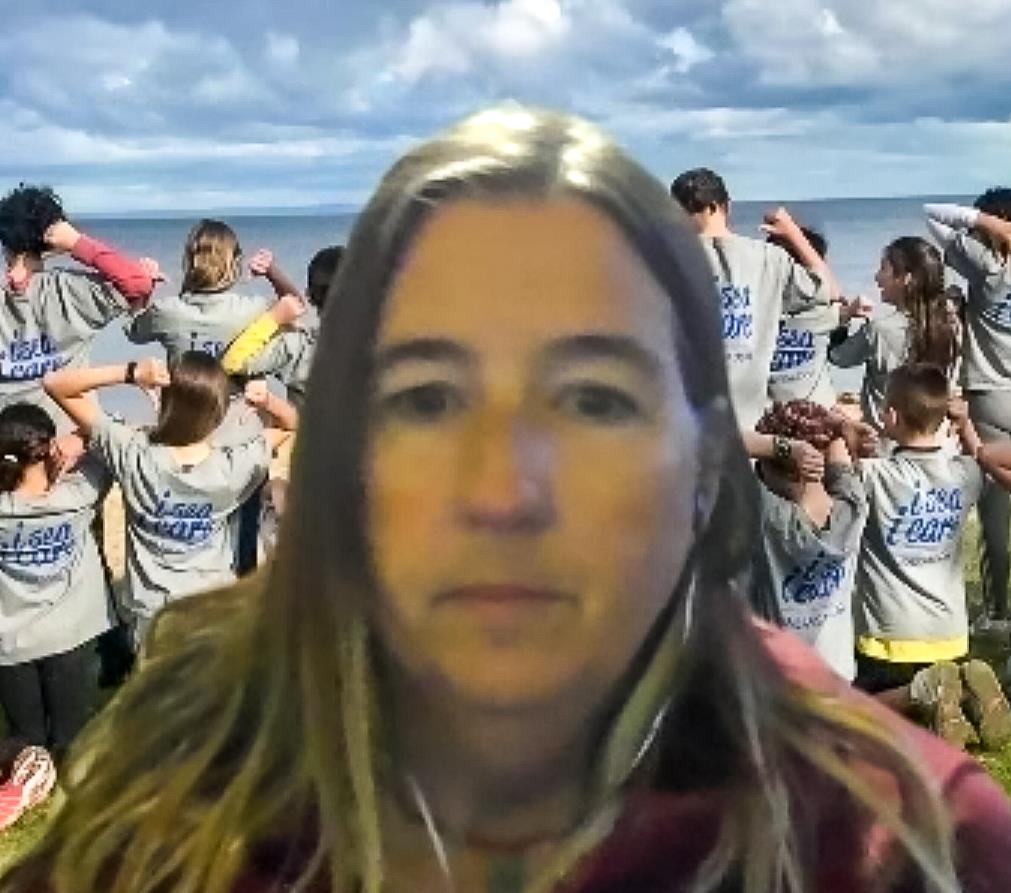
President Elias introduced Mandy Robertson, noting the Dolphin Research Insitute may not be front of mind for many, but it has been in existence for about 31 years, with its primary focus being marine conservation.
The Dolphin Research Institute (DRI) started with volunteers who were passionate about dolphins, focusing on the resident dolphins in Port Phillip Bay.
Social researchers in the early days understood that Victorians “didn’t know about our own backyard” and cared more about the great barrier reef. There was very little awareness of the diversity, and the uniqueness of the species. When we don’t know about something, we don’t care about it, and when we don’t care about it, we can’t protect it.
DRI is now enrolling interns who then continue with their placements as long-term volunteers.
Two resident dolphin species provide the source of investigation and education: the Bottlenose, (Burrunun) dolphin in Port Phillip bay, and resident common dolphins, an oceanic species, found in the deeper waters of Bass Strait.
Group of 13 adult common dolphins moved to Port Philip (as far as is known, the only population of common dolphins recognised as “a bay population”) and has now grown to 84 dolphins.
A tell-tale sign of nearby dolphins are Gannets circling above or diving into the water to hunt for fish. This indicates that dolphins are rounding up their prey into accessible “balls” to feed upon.
When we go out and don’t see dolphins, that’s also important data for us. Gives us their pattern.
DRI also monitors whales, primarily Humpbacks. They’ve been in Antarctica all summer and are now starting to move up to Australia for winter. We look for their tails or "fluke". Their dorsal fins are tiny.
Between 400 and 600 sightings are recorded in a report DRI submits to the International Whaling Commission which helps monitor whale population and its ongoing evolution. Sightings have been recorded from Barwon Heads to Inverloch.
DRI is also a partner supporting the annual Island Whales festival (islandwhales.com.au) at Phillip Island in Victoria. This year the dates are 1 – 3 July. This is an opportunity to see these majestic mammals of the deep as they migrate towards warmer climes as winter approaches.
Questions:
1. Kevin love - Have there been any recruitment of other males in the common dolphin population?
Answer - Originally seeded from the one male but later on other males have come in, and females have gone out. They’ve expanded their genetic pool.
2. Russell Rolls - Humpback whales have been sighted up at the north end of Port Phillip Bay; what do they do there?
Mandy - Sightings have been reported in Williamstown. They come in with the tides and they are very curious and want to have a look around.
3. Doug Robertson - Is a lone dolphin aggressive?
Mandy - They can be, it depends on the circumstances that resulted in being alone in the ocean.
4. Allan Driver - How do we find out more about the Island Whales festival (1 – 3 July)?
Mandy - We are still in the final stages of planning. While some events require prior booking, most do not, and you can turn up to participate. Details are available at islandwhales.com.au.
5. Roy Garrett – There has been only one sighting of a killer whale; why so?
Mandy - we do get killer whales, they tend to be further up the coast. We know they triangulate between here, NSW and TAS.
Chairman Herb thanked Mandy for her insightful presentation.