
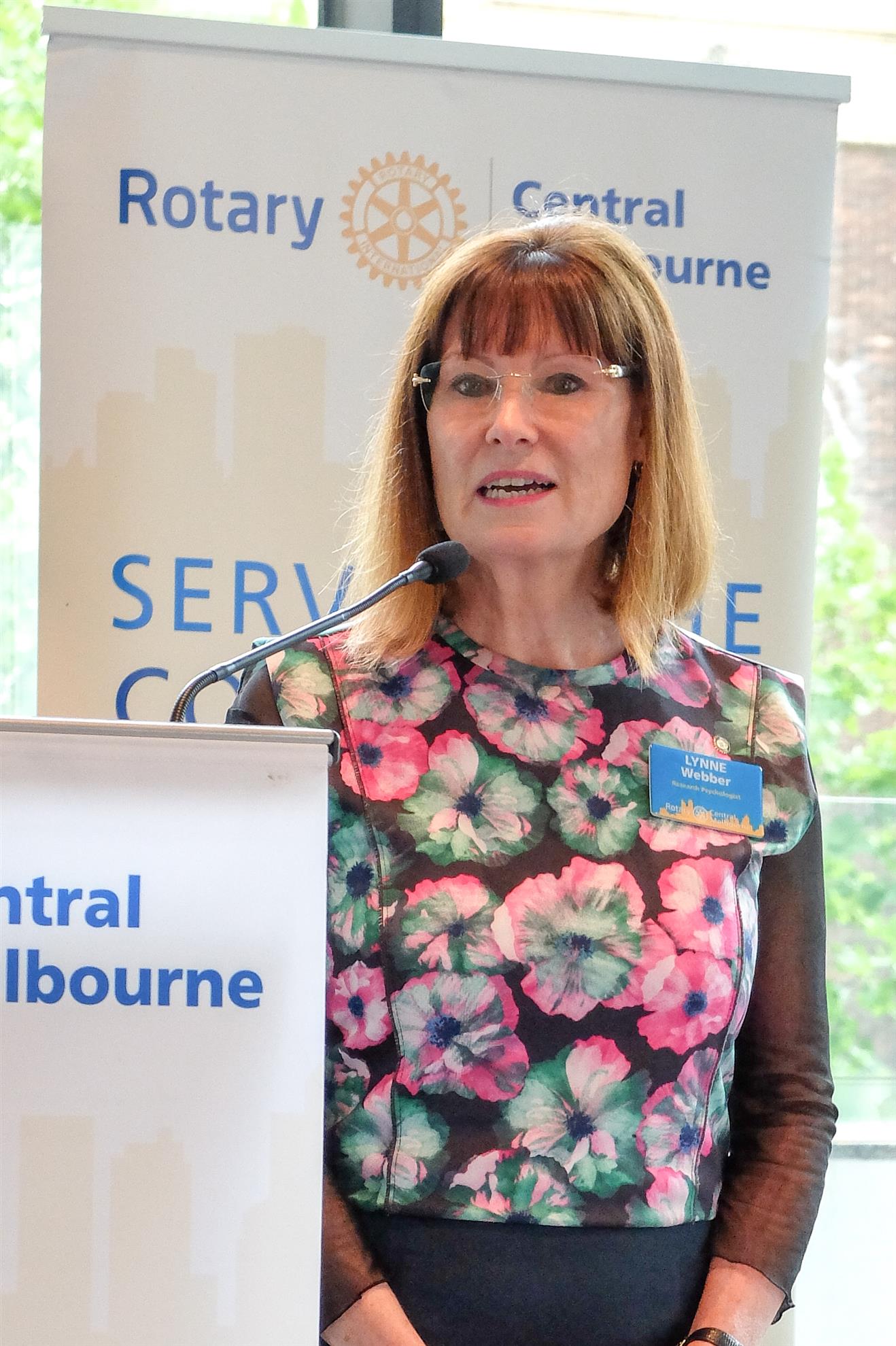
 New member Lynne Webber’s hobbies include sailing – originally taught by her parents on Sydney’s Middle Harbour and Pittwater. “They’re still sailing though dad (Dev) is 90 and mum (Faith) is 88 and has dementia – but luckily her sailing skills have been preserved.”
Lynne’s big passion, outside family, friends and work is the Argentinian Tango. She’s dedicated thousands of hours to improve since 2011. “It’s a very mindful dance because there are no set routines. As a follower I have to intuit what my leader wants me to do, so it requires extreme focus, which is good for the mind.
Her husband Bob, worse luck, has no such passion for tango. She says, “The best dances I ever had was with a stranger in Berlin in 2014. We had an amazing synchronicity: a goal you aim for, but seldom reach.”
She joined Rotary Central Melbourne on January 23 to find new ways to contribute to society – she is particularly attracted to early intervention programs and mentoring programs such as the one for senior police.
Lynne’s first career was as a primary teacher. Seeing the learning difficulties many kids have, she completed a psychology undergraduate degree and Masters in educational psychology at Macquarie University. While there she met Bob, who was completing his Ph.D, and in 1983 they moved to the University of Illinois at Urbana-Champaign, a campus surrounded by cornfields. While he pursued post-doctoral research, she completed a Ph.D in educational psychology.
When Bob transferred to the Chicago campus, she had her most challenging US experience, driving a removal van full of their furniture the 100 km distance. But she soon relaxed when she realized everyone on the road gave way to her.
Alex, their son, was born in Chicago and wanting to give him an Australian upbringing they moved to Melbourne (Bob to a position at Melbourne University and she lecturing at Deakin). After 15 years she felt an urge to put research to practical use and took a State government job to research and reduce use of restraints and seclusion for people with a disability. She works for the Senior Practitioner to oversee the human rights of approximately 2000 clients who receive a disability service and who are restrained.
“The clients range in age from 6 to 65. Although all have an intellectual disability, most have multiple disabilities,” she says. “The vast majority of clients are restrained using chemical restraint, such as sedatives. Our goal is to help disability services make sure restraint is a last resort and then only used in the short-term.”
She cites one case (see the article “Providing positive behaviour support to improve a client’s quality of life”) about a young man who was born with multiple disabilities and grew up in State care. He grew up only knowing institutional care. He wasn’t able to communicate his needs and had learnt that if he hit his head with his hand, his carers would try and work out what he wanted. From the age of 10 and for the next 20 years his carers used splints on his arm to prevent his self-harm. Lynne is really pleased that he’s now been without this restraint since October 2014. Not surprisingly there’s an amazing improvement in his general well-being.