Elias shared how much he enjoys the pre-meeting banter and the chance that this gives for people to connect. A warm welcome was extended to guests
- Teresa Carlson
- Alan Crawford
- Chanti Bou
David Jones welcomed Brett Butland from Predator Free 2050 who is also a fellow Rotarian as a member of the Rotary Club of Orewa-Millwater (District 9910) and a trustee, and former chair, of the Motutapu Restoration Trust.
Brett thanked the club for the warm welcome and noted that he enjoyed the pre-meeting discussion. Originally from South Africa, Brett outlined that he is now based in New Zealand, he is pleased to join with Rotarians around the world and is grateful for the invitation.
Brett has been involved in conservation for almost all his life and identified that similar countries share similar challenges with untold troubles.
Predator Free 2050 is a crown company formed following Sir John Key’s announcement in July 2016 that NZ would strive to be predator-free by 2050. This was informed by conversations over a number of years and insight into the biodiversity crisis that NZ was facing. There is an absence of native mammals except for 2 land-based bats.
Launched in late 2017, the 2 shareholders of Predator Free 2050 are the Ministers of Conservations and Finance. It is a small organisation with recent growth to 10 people, an Agile group focused on the endpoint.
Looking at 4 impact areas
- Proof of concept: Predator eradication at landscape scale on the mainland and major offshore islands
- New tools to make eradication and defense possible
- Breakthrough science to transform the mission
- Community engagement and wellbeing
For 80 million years, the species and ecosystems of NZ evolved in geographic isolation. The biodiversity is unique, evolving in the absence of the terrestrial mammals, except for bats and 50% of NZ’s terrestrial plan and animal specials found nowhere else on earth.
Species that are endemic
- 72% Birds
- 84% vascular plants
- 81% insects
- 7% marine mammals
- 88% freshwater fishes
- 100% reptiles
Auckland is not only a big city, as a region it holds 20% of NZ nationally threatened species, with over 400 threatened species and several endemic species. The Hauraki Gulf is one of the world's richest endemic seabird breeding areas.
There is a strong appetite for the conversation, with over 200 groups in Auckland focused on conservation and threats to the biodiversity which has been impacted by introduced predators and herbivores. 57 bird species have become extinct since human arrival, with 26 million native birds killed each year by predators.
Auckland is one of the weediest cities in the world, Kauri (native forest species) will disappear within the next 30 years. Exotic plant species are five times higher than native species. Pest species in fresh and marine waters are increasing with two-thirds of Auckland’s shore and sea birds at risk of extinction.
A large focus of the work is a proof of concept with 20 projects across NZ covering, 864 hectares and providing anchor funding which will allow groups to leverage access to other funding.
Each project is completely different, ambitious, unique and facing different challenges.
It is easier to contain things on islands, but more ambitious to focus on managing the situation on the mainland. All projects have challenges, particularly around re-invasion and each is managed by a consortium of land-overs, regional leaders, councils and a range of different players working together to achieve a shared outcome. All governance arrangements are independent and represent the community – there is no ‘cookie cutter’ approach.
Predator Free 2050 provides project support (wide-ranging from funding to analytics to media) and information, based on Mahi Kotahitanga partnership principles. All projects are unique, each providing and sharing learnings mutually.
There exists a wonderful, collaborative atmosphere with everyone working together, learning a lot with various methodology and delivery approaches and devices being used. Technology is very important, with a focus on precision and discipline. Size counts, and there is a great need to focus on scale, boldness and ambition. They are learning to expect the unexpected, a curious mind is the most important asset along with being agile and innovative. The current phase is about trying, demonstrating and getting proof of concept; understanding that eradication and suppression are different, and the treatment is reflective of this.
Emergent topics include patches to swathes, DNA analysis and a focus on science and techniques. New tools to support eradication are being developed.
Emergent research is being funded powerfully to stimulate the learnings; the focus ahead is to mobilise projects, look at strategic investments that are non-government and co-funded and also focus on Maori aspirations to restore taonga species.
David thanked Brett for his presentation and invited questions/discussion
- What were the apex predators – birds of prey and there are enough to achieve a rebalance in the future
- Is there a home-owners pack – there is a range of information on techniques, devices etc that can be onforwarded
- An array of invasive species more so than Australia, but no mention of foxes or feral pigs, interesting how the 2 continents ended up with a different array of invasive species – true, with some of the species bought in to control the other invasive species. There was the not same knowledge or benefit of hindsight. Hedgehogs comprise 7 genera - more diversity than in Europe and UK where they are threatened. Wallabies were sent from NZ to Qld. NZ hedgehogs are a huge pest, yet are endangered in the UK.
David Jones extended thanks to Brett, particularly noting the topic was of great interest to members of the club: great to have the NZ influence and information as part of the meeting!
Member Milestone Announcements
Member Birthdays
Martin Langton 19th September
Partner Birthdays
Rankin le Roux, Adele’s partner 13th September
Wedding Anniversaries
Sarah Overton and David Duncan, 6 years, 19th September 2015
Date Joined Rotary
Rebecca John 20th September 2016
Member Announcements
- Warwick – provided an update on the International Student Program with pilot #2 underway. Information can be found on rotarymentors.org.au – please go to this for more information including a new registration process. Looking for 50 mentors in the next month, with a 1 hour per fortnight commitment required. The system will match mentor with mentee with the first meeting online, hoping that beyond this face to face meeting may be possible
- Allan reminded members to send their Working With Children Checks information to Tom Callendar
Inquisition: Brett Jones
Brett introduced Teresa Carlson, a well-known guest of the online RCM meetings, and welcomed her to this weeks’ Inquisition.
Teresa is the President of the Echuca Rotary Club.
Teresa arrived in Australia as a 6-year-old from Holland with her 3 older brothers, leaving in 1958 and spending 6 weeks on a boat to get here.
The family settled in Doveton with her Mother’s brother. When her father was 18 he was taken by the Nazi’s and given he spoke German, they sought for him to work with them, but he escaped via a visit to a tailor.
Recently Teresa retraced her father’s steps and learned more about this story. Teresa completed secretarial studies.
Her husband Richard was her brother’s friend who was a date when she needed one at 16, this led to them being married at 19 with 3 children. Having lost 2 children to cystic fibrosis, Michelle and Michael, this condition is now a topic of passion (having raised >$1M) along with Rotary.
Teresa has been with Harvey Norman for close to 30 years. She is interested in car rallies which is a fabulous fundraising platform. Rotary has followed her career path from Townsville to Perth to Melbourne to Shepparton to now to Echuca along with other places. In response to the inquisition question about food – Teresa favours an iconic Dutch dish - Sauerkraut, mash potatoes and rotwurst sausage with lots of mustard!
Another insightful and interesting inquisition – thanks Teresa and Brett.
President Elias’ Announcements
- Chanti was invited to introduce herself and identified that she has recently resigned from Rotary Club of Melbourne and looking at her next venture
- Tuesday morning meetings will continue to be via zoom until further notice
- The Board is meeting on 15th September – all welcome to attend, just let Allan Driver know so you can have all details including an invitation
- Save the date for the district conference to be held on 1st May 2022
- This Saturday at 10 am is the first morning tea with the DG (District Governor) – details will be circulated following today’s meeting
- Thanks to Alan Crawford and Chanti Bou for joining today’s meeting
Next week’s guest speakers are two Associate Professors from RMIT – Pathways to Ageing
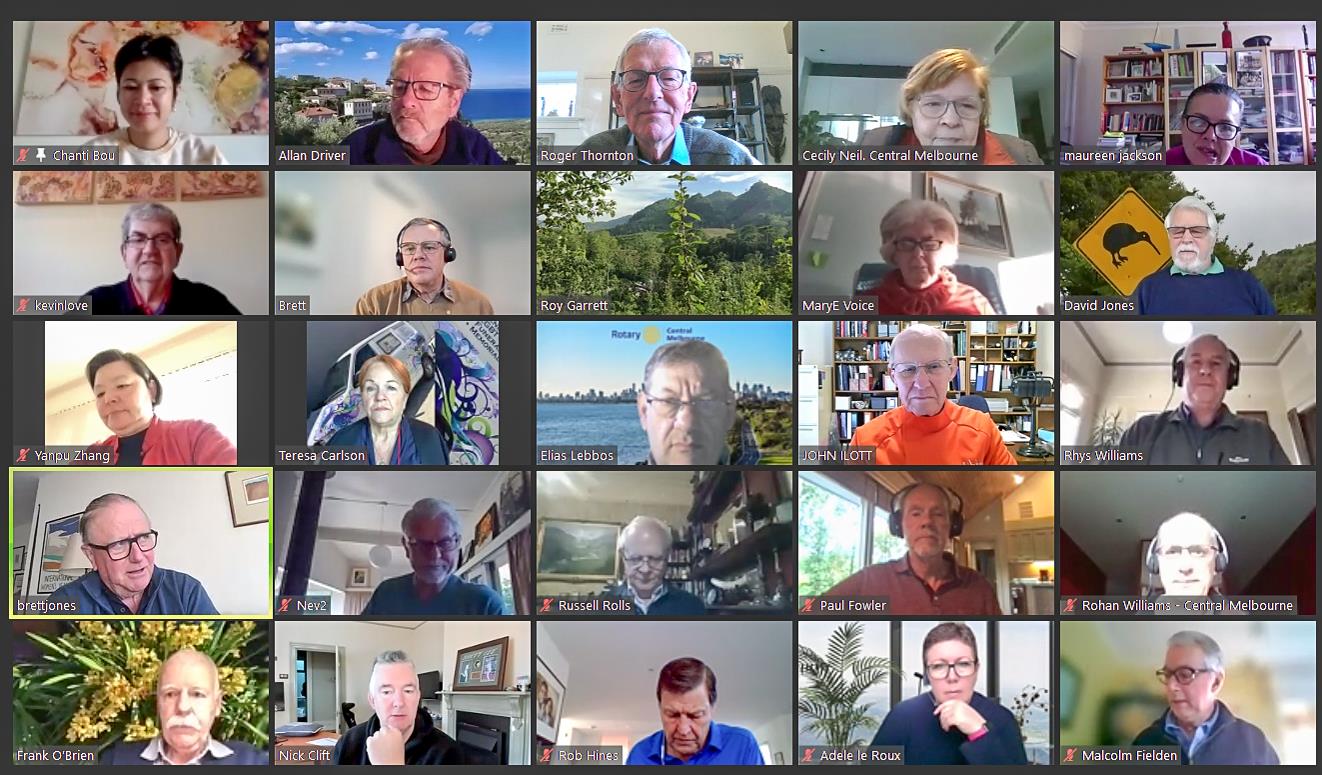
Virtual seating arrangements: Each fortnight a seating plan will be sent to members. Members are encouraged to connect with people either side of them on the list. Keep connected in these times of isolation.
No other announcements. Thank you to David Jones for undertaking the Chair role at short notice.
Thanks for visiting Rotarians, any guests of members and potential members.