
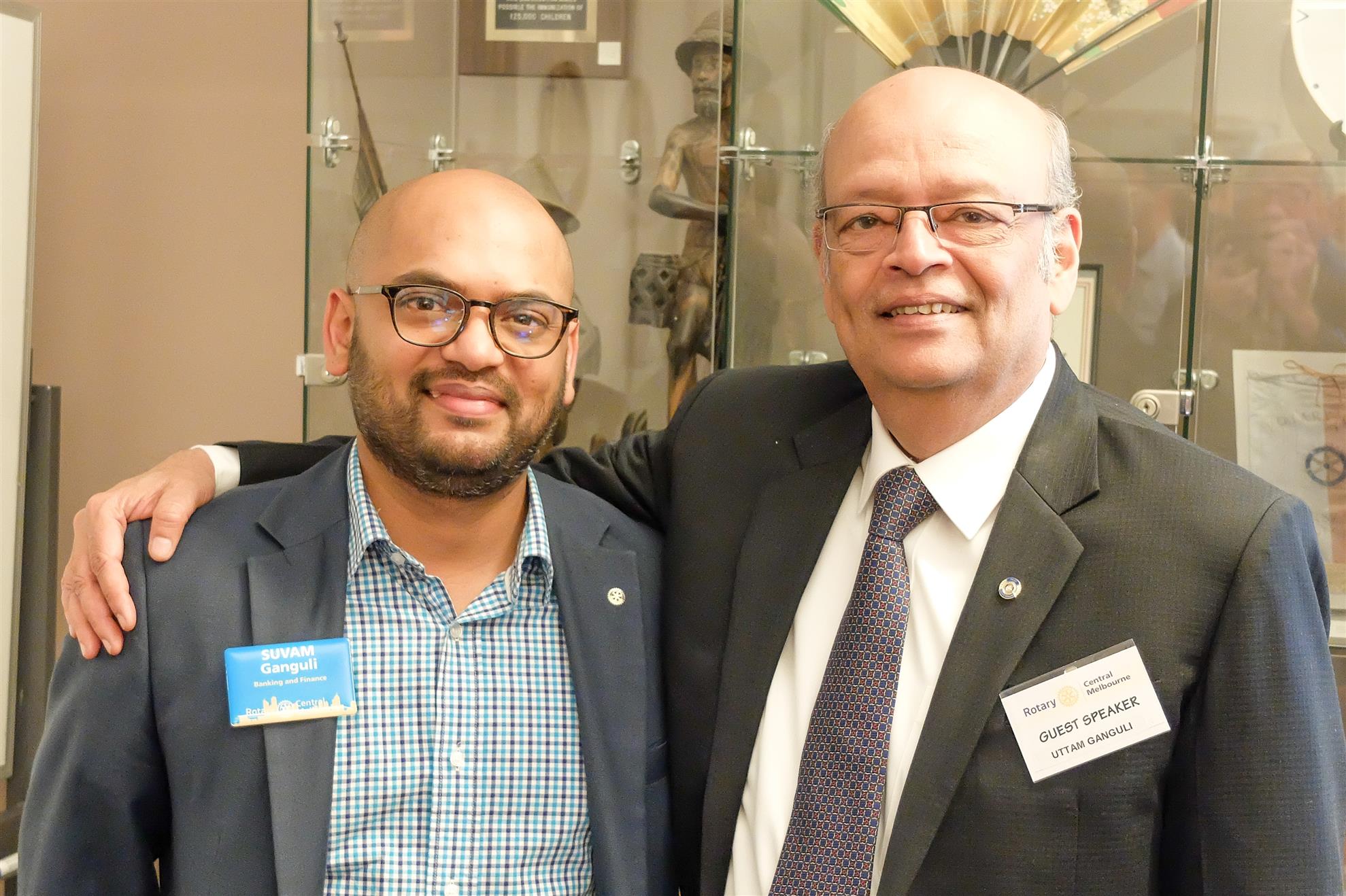
 Uttam Ganguli was reintroduced to give the main talk. After an exchange of gifts and flags, we learned that Uttam joined RC Rabindra Sarobar Calcutta in 1993 as the Charter Secretary and has served the club and district in various positions. He currently chairs the Polio Plus project and is focused on finishing the job to eradicate polio worldwide.
In India, there are 38 Rotary districts across 3 zones, with a total of 143,941 members. The country punches above its weight in many aspects, including contributions to Rotary Foundation (India is responsible for 84.3% of SE Asia’s annual funding)
Photo: Uttam and son, RCM member, Suvam
District 3291 alone holds 148 clubs and 3,886 members, and spans a geographical area of 71,000 square kilometres where 51 million people live. The first Rotary Club in Asia was established in Calcutta in 1919 with 20 members. They met at the Grand Hotel, an impressive Victorian building whose façade remains largely unchanged today.
District 3291 supports initiatives across all 6 areas of Rotary service. Highlights include:
Peace: All faith meetings (the Dalai Lama even attended one!)
Disease Control & Prevention: Eye surgeries at clinics owned and administered by clubs in 2017 performed 40,000 subsidised operations, and 15,000 free ones.
Water & Sanitation: Ensuring safe drinking water in remote and rural villages and installing toilet blocks to improve sanitation.
Maternal & Child Health: Vaccination advocacy, cervical cancer screening and a range of education programs on sanitation and general health.
Basic Education & Literacy: Bringing dropouts back to school, E-learning and upskilling for teachers.
Economic & Community Development: Skills and vocational training. One project highlighted was teaching women to grow mushrooms for market in micro-farms at their home.
As District Chair of the Polio Plus project, Uttam spoke about the importance of this work, both in eliminating the last remaining instances of polio and also in preventing the disease’s resurgence. In 2017 only 7 new cases were recorded, in 3 countries (Afghanistan, Pakistan, and Nigeria). So far in 2018, 1 case has been reported in Afghanistan. Uttam emphasised there is a real risk of polio coming back if measures around vaccination and sanitation relax. Polio is a water-borne disease, so preventative measures remain critical.
The major effort underway now is the “Switch” program, changing over from trivalent to bivalent oral poliovirus vaccination in order to reduce the risk of vaccine-derived poliomyelitis.
Rotary International has contributed $1.6 billion to Polio Plus, of which India’s significant contribution is $193 million.