
ROTARY MEMBERSHIP TRENDS
Posted by Tony THOMAS
Chris Egger, D9800 Membership Director and Tony Thomas have produced a report on Rotary membership trends, starting with global figures and then drilling down to Australasia, Australia, D9800 and RCCMS.
The report is attracting interest so far at top levels in Zone 7B and 8, D9800, D9810, and across in WA’s D9465. The report will be disseminated en masse as soon as Tony has completed a Part 2 report in (hopefully) a few days. This 5000-word report is a very detailed analysis of the success of Rotary of Crawley as a 21st century model of how Rotary ought to be operating.
The membership report defies the Rotary convention of not making useful management-style data and time series publicly available, in contrast to some comparable bodies. It involved authors in considerable frustration in accessing data, as bits and pieces can be found here and there, but never in a logical format. The report, for the first time to the authors’ knowledge, provides a detailed comparison of Rotary and Lions membership trends.
Comprehensive data is available within Rotary but not publicly. Some key data was discovered buried in a PowerPoint delivered to a British Rotary convention several years ago. Here’s some key findings in the report:
- Internationally and in the Australian region, Rotary as an institution is in worse trouble than most members realize. Lacking this perspective, clubs tend to continue in their conservative and traditional ways, while their membership shrinks and ages.
- Rotary’s membership situation has deteriorated significantly on the basis of members per 100,000 of population. In Australia, for example, the actual fall in the past 22 years is about 28%, but per capita membership has halved.
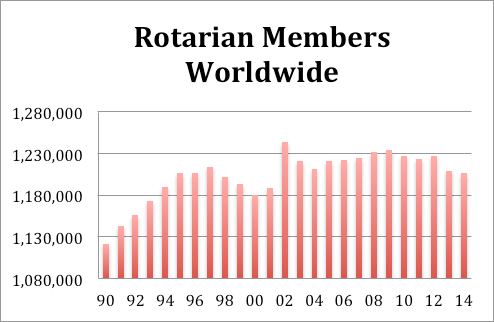
- Global Rotary membership has been static at 1.2m for 19 years, with membership declines in most developed countries (except for German speaking countries) matched by growth in many developing countries, in particular India.
- In the decade to 2013, USA members were down 15%; England 16%; Japan 21%, and Australia and Canada, 14% each. India was up 38%; S. Korea 26%; Germany 27%; Taiwan 49% and Brazil 8%.
- The Australasian Rotary zone is in worse-than-average trouble with ageing membership. At 2012, 83% of zone members were aged 50+, compared with 70% for Rotary worldwide. About 33% were retired, compared with 21% worldwide. There appears a risk of a sharp membership fall in 2022 as a ‘bulge’ of older members passes out of the system.
- For District 9800, member numbers have fallen from 3,133 in 1998 to 2,445 currently, down 22% in 16 years. . In the past six years the membership fall is 9%. Currently for each club having a good year on membership growth, about two are downsizing. The number of clubs is stable but average club size in the past six years has fallen from 38.3 to 34.4 members.
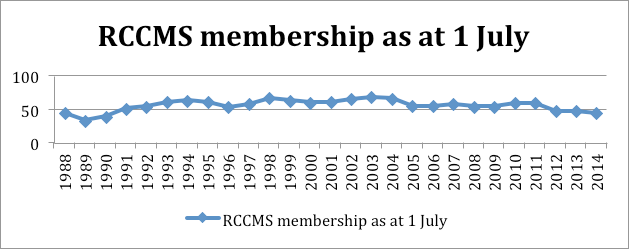 RCCMS commenced with 44 members and 26 years later has 45 members. The peak was 68 in 2003 with a slide thereafter.
- The Lions Club movement globally and in Australia, appears to be outperforming Rotary on membership, although some special factors are involved. Both groups are of similar size.
Copies of the report available from Tony on request or a version (minus graphics) is at https://tthomas061.wordpress.com